
OCD
Psychologist Maarkedal OCD
Are you experiencing obsessive thoughts or compulsions and looking for clear explanations and help? As a psychologist in Maarkedal, I will help you with Cognitive Behavioral Therapy, tailored to your situation. On this page you will find recognition points, treatment options and practical exercises. Read on or make an appointment for an intake.
CHARACTERISTICS OF AN OBSESSIVE-COMPULSIVE DISORDER
There is a gradual transition from ‘normal’ compulsive traits to ‘pathological’ compulsions.
Someone has a compulsive disorder as the:
- compulsive thoughts/actions consume FULL TIME
- Compulsive thoughts/actions cause FULL LAST
- daily functioning is disrupted.
- person feels that the compulsive thoughts/actions do not belong to him/her
- acts are undesirable
Usually people have both compulsionthoughts as coercionacts
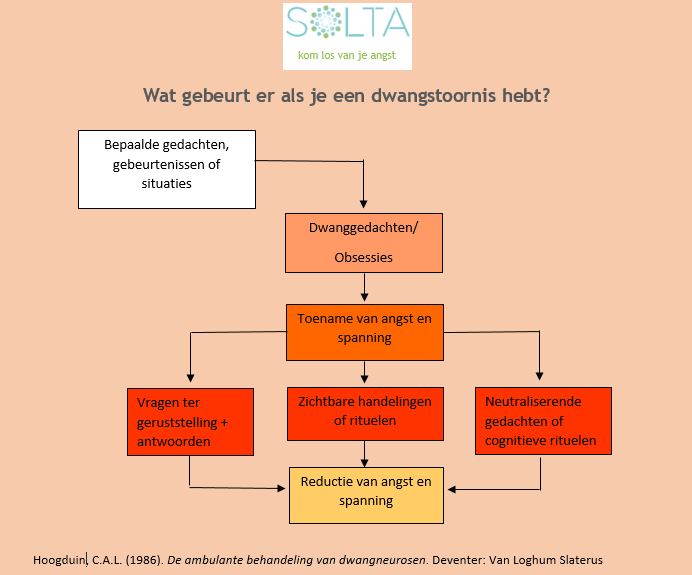
- coercionthoughts or obsessions Are recurrent, persistent thoughts or (thought) images. They are unpleasant and disturbing and cause a feeling of tension, anxiety and restlessness. One then often tries to ignore or suppress them. But often they do not stop until certain actions are performed.
- coercionacts or compulsions are actions or rules that a person consciously performs or applies in a certain way to stop anxiety and agitation. For example, one consequence is that a person must list all the license plates of blue cars out loud to prevent a family member from becoming seriously ill or having an accident. The compulsions may also be invisible to the outside world, if the thoughts as rituals are performed. e.g. that someone must repeat a question from themselves 3 times before they are allowed to give an answer.
TYPES OF COMPULSION PROBLEMS

COMPULSIVE PERFECTION AND CLEANLINESS
Someone who suffers from this is constantly thinking about things they didn't do neat, perfect or good enough has done. Such a person is constantly straightening and cleaning things up. This can cause tremendous inertia. E.g. spending hours ironing, organizing the desk,....
CONTROLEDWANG
A person with control compulsion constantly checks whether e.g. the gas is off, or the front door is locked,... . Often he/she must repeat the act a number of times (eg pulling the door a third time) to make sure she is closed.
SMETVREES
Someone with this compulsion is so afraid of dirt and contamination that he/she will attack the invisible microscopic dirt particles and bacteria in a variety of ways.
Some people spend hours scrubbing their hands, avoiding contact with faucets and toilets or not daring to shake hands with anyone. Others have to shower again after every outing ...

COMPULSIVE THOUGHTS ABOUT VIOLENCE AND SEXUAL MATTERS
A person with these compulsive thoughts sees in his/her mind images that he/she attacks, beats up or hits someone. Or that person is afraid of harming his/her own children with a knife or scissors, or is afraid of having a sexual preference that he/she feels is wrong,...
The person fears that he/she will actually carry out the imposing images. The images and thoughts usually evoke a great deal of fear. The fear subsides when a good number of times a counter-thought or ritual action has been performed. Often the fear leads to avoidance of certain situations or of means by which a person could do the deed. For example, the person in question then puts away all the scissors and knives and gives the key to someone else.
MODEL OF HOW COERCION WORKS
TIPS

TIP 1 : KEEP A JOURNAL FOR YOURSELF
Keep track for yourself in what ways and when you suffer from your compulsions. For example, you may describe which event preceded your complaints and what thoughts, behaviors and feelings you had in the process. This helps to identify which events your symptoms are related to. That way you can also get clearer for yourself what underlying fears you are trying to control.
TIP 2 : DO NOT CHECK MORE THAN 1 TIME
If you find yourself checking certain things repeatedly (eg is the gas off or the door closed?). If you are constantly checking whether you did something correctly, the confidence you have in your own memory diminishes. So it is important to no longer than to check 1 time!


TIP 3 : MAKE A MENTAL PICTURE AND NOTE
Do you often doubt your own memory? For example, do you often worry about whether you have closed a door? Then next time you ask that action, try to do in a conscious way . Make a mental picture of the moment itself at the time you do this and tell yourself, ‘the door is locked. You will find that you are less likely to doubt your memory this way.
TIP 4 : DO BREATHING AND RELAXATION EXERCISES
When you expose yourself to your fears, it's nice to have skills mastered that keep your body and mind calm. Breathing and relaxation exercises can help you cope with more difficult situations.


TIP 5 : DON'T TRY TO AVOID SITUATIONS
Avoiding situations you fear actually perpetuates your anxiety.
When you learn to seek out situations you are afraid of, it helps reduce your anxiety in the long run.
WHAT HAPPENS IN THERAPY ?
Cognitive behavioral therapy is the most appropriate form of treatment for compulsive disorders. In therapy, the person is exposed (in thought or in real life) to the situations or objects that trigger the compulsive thoughts and anxiety and agitation.
The person is trained in this to persevere in those situations and the endure compulsive thoughts without performing compulsive acts. Treatment also usually involves homework.
Therapy may also focus on the fears that lead to the compulsive thoughts and actions. Sometimes there are underlying factors that trigger things today. The method of e.g. EMDR can then be an important tool in this I notice in practice.
Supportive techniques that can be used in addition are relaxation exercises, assertiveness training and techniques to learn to put things in perspective and express feelings.
The treatment requires great commitment from the client and the environment but the results are good in many cases. In 80 percent of the clients, the compulsive symptoms diminish to such an extent that they can live well with them.
DOES MEDICATION HELP ?
In many cases, there is no real need for medication.
With a severe form of obsessive-compulsive disorder, however, it is more common to take medication first, and later combine it with therapy. This is a personal choice that you must fully support.
The most commonly used medications are so-called kind of anti-depressants
USEFUL ORGANIZATIONS
- Vlaamse Vereniging Angst en Dwang (VVAD): this is a self-help group for people with OCD (obsessive-compulsive disorder) and people facing it. www.vvad.be
- www.dwang.eu
- www.gedwangenis.be
INTERESTING LITERATURE

This book is partly a self-help book.
One way you can find out, using a test, to what extent your compulsive symptoms affect your life.
In addition, several stories are shared from peers. You will also find explanations of how therapy will work around your problem.

Also in this booklet you will find many tips on how to address your problem.
The booklet is divided into causes, treatment options and self-help techniques.
If you feel the need for further assistance and would like me to look around with you, please let me know. You can make an appointment via this button.