
PANIC
Psychologist Maarkedal panic
Are you experiencing sudden, severe anxiety or panic attacks and seeking targeted help?
As a psychologist in Maarkedal, I guide you with CBT, breathing and exposure exercises to reduce panic.
On this page you will find recognition points, effective treatment options and practical exercises you can apply immediately.
Schedule an intake or read on for more information.
WHAT IS PANIC
Panicking is normal and even a healthy response in a (life) dangerous situation. Panic protects you by acting immediately to avoid the danger. E.g. by jumping away when a speeding car suddenly approaches.
When you have a panic disorder , you get without any ‘real’ danger , recurrent panic attacks. These are sudden, short periods of intense anxiety. That anxiety is so intense that you become afraid of having another such attack.
WHAT ARE YOU FEELING?
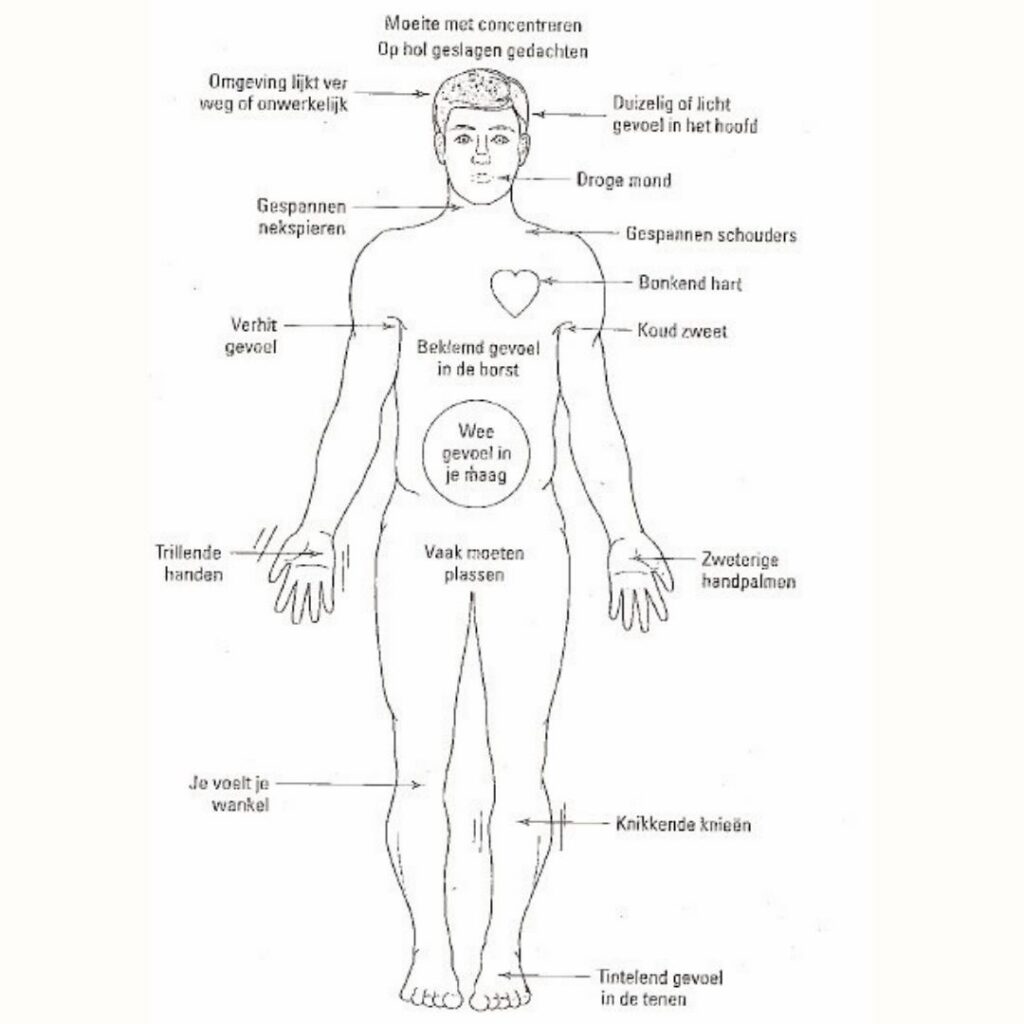
Heart palpitations
Stuffy feeling
Sweating
Trembling/tingling hands
Cold chills
Stiffen
Dizziness
Nausea
Fear of dying
Fear of losing control
…
HOW DOES PANIC DISORDER OCCUR ?
As with most mental disorders, there is no specific cause to point out. If panic attacks run in your family, you are more likely to develop them as well. There is then also a familial predisposition.
Panic disorder sometimes begins after a shocking event For example, the death of a family member or work stress.
Once you have experienced a panic attack you start paying more attention to the signs. You also avoid situations that might lead to a panic attack. We call that avoidance. For example, you no longer go to crowded stores. This is an understandable reaction. Because in the short term it provides relaxation and peace of mind. BUT in the long run, that avoidance behavior is harmful. For it causes the anxiety to persist and may even increase. It prevents you from discovering that what you fear is not happening.
Also importantly involved in the creation and persistence of anxiety are our thoughts. This is because fear causes you to estimate the danger to be greater than it really is. For example, you think you would die if you had a panic attack. While that is not logical.
WHEN DO YOU NEED HELP ?
Do you suffer from panic attacks? If so, you may have a panic disorder. You need help if the panic attacks interfere with your normal daily activities, such as work or sports.
Have doubts about whether you need help. Discuss this with your doctor.
HOW DOES COGNITIVE BEHAVIORAL THERAPY HELP PANIC ?
Your behavior and thoughts keep the anxiety going. During counseling, you will actively work on changing them In addition, it is important that you learn by experiencing things. That happens step by step.
You will also work on the way of thinking that accompanies the panic attack. Are the thoughts real. Do you ever pass out? With the therapist, you examine which thoughts are not true.
TIPS
TIP 1 : ACCEPT THAT YOU ARE HAVING A PANIC ATTACK
If you have a panic attack, its further development is fueled by what you feel physically and the irrational fears about external things. (Eg you are going to die; your house is on fire ; you are going to lose your job,...)
Important to realize around panic attacks is that even though everything seems to indicate to yourself that you are dying, it not actually happens! Very often an attack is accompanied by palpitations, BUT, it is also possible to have an attack without these palpitations.

Remember that the terrible wave also goes away again!
Other symptoms include shortness of breath, sweating, being dizzy, feeling like you are suffocating and tingling in your fingertips and other limbs. This is why people often mistake this for a heart attack and go straight to the hospital.
What is its difference?
Panic attacks are often short-lived. They diminish after 10 minutes, allowing you to recover fairly quickly. It is important to realize and remember that a panic attack occurs like a GOLF, with a peak, which then slowly subsides.
If you can reassure yourself that it will get better after a few minutes, it is easier to deal with it.
If you're sure it's a panic attack, the best thing to do is to do NOTHING. It's a FALSE ALARM and your body tells you all kinds of things to do, but you don't actually have to do them. If you sit it out, it will go away.
BUT! Of course, none of the above applies if the feeling doesn't subside OR if you have another medical condition that makes the acute symptoms feel like a panic attack, because many of the symptoms of a panic attack are similar to other medical ailments.
TIP 2 : FIND A QUIET PLACE TO BE ALONE FOR A WHILE

It does happen more often that a panic attack occurs in public or social settings. As soon as you feel an attack coming on, try to move to a quiet place. For example, pretend you need to go to the bathroom. People almost never wonder why you have to go to the toilet.
BUT beware! Do not increase your anxiety by then suddenly going home during an event OR by not even going there at all. At such a time, it may seem like the best short-term solution for yourself. However it only reinforces the idea that the situation is dangerous, making you less easy to get rid of in the long run, and only making your world smaller.
TIP 3 : FOCUS ON SOMETHING ELSE TO GET OUT OF THE MOMENT
Anxiety attacks give a uncontrollably dark predictive sensation about the future. Therefore, it is important that you try to keep yourself in the moment of the NOW.
If you are with someone who knows about your panic, they can help by saying to you things that you derive.
A somewhat more ‘active technique’ is to do something else with the energy that is in your body. A kind of ‘reassessing your anxiety’. When you have anxiety, your body and mind are very fired up. It is then easier to turn that energy into a movement or an action instead of meditating. It's a useful technique when you've tried your best to stay calm but couldn't take it anymore. You can e.g. jump up and down hard.
After all, exertion causes you to breathe DEEP rather than hyperventilate, and it helps you reconnect with the physical reality that is around you. On top of that, it keeps you from being in your head, where everything is just big chaos at the time.
TIP 4 : DO THE RIGHT BREATHING EXERCISES
There are several forms of breathing exercises that are suggested. The breathing deeply or the famous puff-in-a-bag doesn't always work. Deep breathing can cause a person to take in too much oxygen, causing dizziness and shortness of breath.
If this doesn't work for you, you can try using ‘breathing ’normally during a panic attack. This will stabilize your breathing.
Around this you will find many apps on your smartphone or PC.
TIP 5 : STICK TO THE TECHNIQUES THAT WORK FOR YOU
If there is a particular technique that has helped you in the past it is reassuring for yourself to know that you always have it with you. For example, you may have a list of methods that you can use. You can keep this list in your wallet or on your smartphone.
A very efficient method is still to get as close as possible to your physical experience of a panic attack, without actually having one. Through this exposure to symptoms (e.g., by inducing feelings of dizziness or hyperventilating), your body learns to associate these symptoms with feeling safe and okay. But for the latter, it is best to be guided professionally.
If you would like further discussion and guidance on this, please feel free to contact me via the button below
Back to the main page
Connected to practice Solta at Ename